
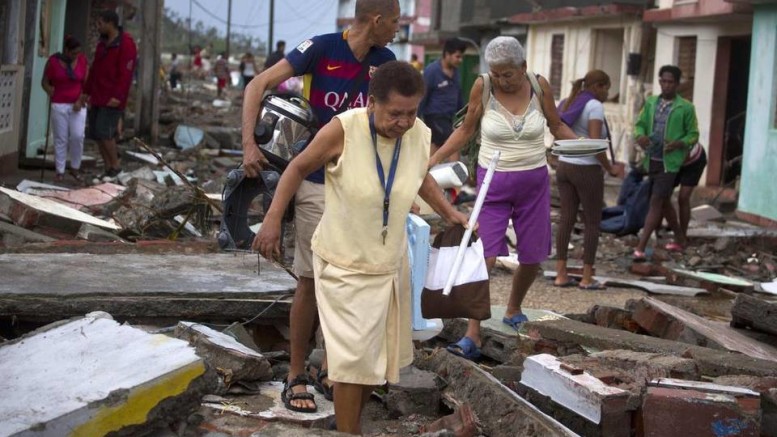
Baracoa’s main beach was already chaotic. A jumble of sandcastle makers, futbolistas and free divers who would run from afar and plunge into the Caribbean Sea. On Tuesday night that same sea turned against Cuba as Hurricane Matthew passed through on its ruinous course through the Caribbean.
Baracoa’s Bahia de Miel is now awash with cement and broken brickwork. Sandcastles and peoples homes have fallen with similar ease and it is unclear when residents of Cuba’s oldest town will be able to play, kick and dive again.
Hurricane Matthew took houses and infrastructure from the east of Cuba, but it left lives- there are still no reported deaths throughout the three ravaged cities of Imías, Maisí and Baracoa. Meanwhile in Haiti, which experienced the same Category 4 storm, the death count is approaching 900. With a new outbreak of Cholera, due to sewage mixing with burst water pipes, that figure is likely to rise.
In the U.S.A, there have been 15 reported deaths at the time of writing and when Matthew hit the south east coast it had eased slightly to a Category 3 hurricane.
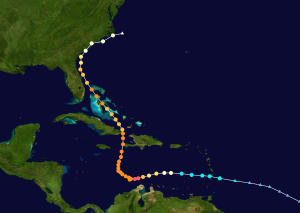
Hurricane Matthew Track. Photo (cc)
Looking at the regional damage to lives, Cuba’s lack of fatalities is admirable and there is no luck nor psychokinesis from the Castros at play. “Extensive preparation. That’s why nobody died.” Cuban diplomat, Luis Marron says.
380,000 people were evacuated from Cuba’s orient in the lead up to Hurricane Matthew. All available means of transport were deployed, the evacuees’ possessions were held in safe spaces and schools and town halls in surrounding danger-free provinces were transformed into community shelters.
It seems that the solitary remaining figures left to face Matthew were the hooded men in orange all-in-ones and the guards of Guantánamo Bay Prison. A U.S Department of Defense announcement declared that inmates of the infamous prison, which lies in the direct path of the hurricane, were made to stay despite the evacuation of 700 military guards and family members and 65 of their pets!
In the immediate aftermath, rats were the only animals left in Baracoa, now they scuttle around the ruins as the evacuation plan is reversed and people return to the harrowing scenes. While the material situation is grim now, the Cuban preparation process seems to be getting more advanced with every inevitable natural disaster that hits Hurricane Alley.

The process of evacuation begins from the coast off Santiago de Cuba. Photo (c) Cubadebate
The civil defence sprung into action across the regions at risk, pruning trees and reenforcing windows in the week before Matthew was set to strike. Hardware stores were also closed in advance to ensure there were building materials in stock for the reparation process.
In some provinces such as Las Tunas, new communication techniques were introduced, allowing residents to tune into a live update radio station from their phones.
Not that communication was previously a weakness in the nation of a few, centrally managed channels. Asked when warnings first started, Luis Marron said “It feels like a century ago- I think it was still a tropical storm when we started getting all the necessary information and warnings”. With limited media outlets and many viewers, disaster warnings are wired effectively to Cuban’s homes and updates and advice frequently interrupt soap operas even to announce early risks.
Alongside effective communication, ecologists Pichler and Striessnig have stressed the importance of the Cuban education system when researching the inequality of disaster preparation in the Caribbean. From interviews conducted in 2013, they found that the vast majority of Cuban children are told of disaster prevention plans in primary and secondary schools, where attendance is exceedingly high. Schools worked in conjunction with local Committees for the Defence of the Revolution (CDRs) to create information networks and train students in primary schools to inform class mates about preparation strategies. Leaflets are also widely distributed.
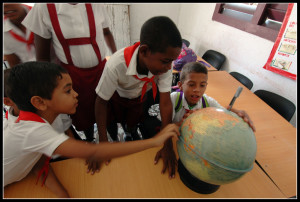
Students of all ages were well informed in the lead up to Matthew. Helping to expel the threat of fatalities. Photo (cc)
The importance that the Cuban state attaches to proper disaster preparation can be traced back to four years after the revolution, when Hurricane Flora took 1157 lives as it meandered across the islands borders for four days in 1963, setting back Fidel Castro’s agrarian reform plan, again, four years. Castro still rejected monetary AID from the Kennedy administration and from then on built a ‘culture of safety’ to protect against disaster fatalities.
Today, Cuba offers emergency doctors to neighbouring countries who are victims of hurricanes. In 2005, Fidel Castro achieved a strange moral revenge from 1963 as he offered medical aid to New Orleans in the aftermath of Hurricane Katrina, he is quoted as saying “Others have sent money; we are offering to save lives,”. The inevitable happened, the offer was rejected on political grounds and Katrina’s death toll reached close to 2,000.

The ‘Henry Reeves’ of 38 Cuban medical professionals leave for Haiti. Photo (c) Ismael Francisco
Haiti does not have the luxury nor the will to reject such offers, as a group of 38 Cuban doctors set off across the Windward Passage on a mission to help the victims of Hurricane Matthew. They will join 600 fellow Cuban medical professionals already based in Haiti. “Our role is to have a positive impact so that the future situation improves and the suffering of the Haitian people diminishes” The Cuban Minister of Health reflected to state newspaper Granma, before waving the 38 professionals onto the plane.
The same state newspaper refuses to show the truly disheartening images from the Cuba’s orient however and despite the wonder of the lack of fatalities, there are still houses and communities to be rebuilt closer to home. The post-Matthew chaos must be cleared away so that Baracoa’s Bahia del Miel may return to its old harmonious, chaotic state.
