
Analyzing the relationship amid the Puerto Rican government and the United States’ Federal Emergency Management Agency (FEMA)’s National Incident Management System (aka NIMS) offers a unique case study to the emergency and disaster management field and beyond. The Caribbean island’s recent natural disaster aftermath and highly publicized aid controversies particularly highlight the importance of cross-industry cooperation. The topic is furthermore exemplary due to Puerto Rico being a US territory, and that status being up for debate. FEMA and NIMS may also be withdrawn due to recent mainland US administrational decisions.
Defining NIMS proves increasingly imperative. According to FEMA, “NIMS provides a consistent nationwide template to enable Federal, State, tribal and local governments, NGOs and the private sector to work together to prevent, protect against, respond to, recover from, and mitigate the effects of incidents, regardless of cause, size, location, or complexity”.
FEMA and NIMS have overall major aid power and potential in Puerto Rican recent events. However, institutional interactions have been by no means perfect. Analyzing how NIMS’ adoption, training and ongoing requirements on the island thus becomes essential elements of which to acquaint.
Adoption

Puerto Rico’s adoption of NIMS involves the hypothetical advantage of aid and advice from also many other entities thanks to its geo-strategic positioning and relationship to the North American superpower. Photo (c) RT 2017
As a US territory, Puerto Rico adopted many Homeland Security and general FEMA initiatives during President George W. Bush’s implementation of them in the September 11, 2001 attacks‘ wake. Such proved an overarching strategic move on the Puerto Rican local government’s part. Not only is the island located in an area rife with natural disasters, but also multi-national commercial interests.
The US Coast Guard aided local Puerto Rico officials during a 2006 joint oil pollution response exercise. It took place on the island in preparation of potential major oil spills there and in the US Virgins Islands. The exercise’s goal was to test NIMS’ ICS (Incident Command System) abilities. ICS is, “a disaster management tool based on a series of rational bureaucratic principles similar to those often discussed in organizational studies as classical management theory”. The exercise additionally focused on increased training of local entities, as well as updated equipment and response time for aid from the mainland United States.
Puerto Rico’s adoption of NIMS involves the hypothetical advantage of aid and advice from also many other entities thanks to its geo-strategic positioning and relationship to the North American superpower. NOAA, the US Coast Guard, as well as various private sector oil exploration multinationals have contributed to NIMS’ implementation on the island for nearly two decades. Such therefore entails patent public and private symbiotic harmony.
Training
Fidel Rijos is a key figure in governmental and business endeavors on the island who helped train thousands of Puerto Rican officials through NIMS certified instruction courses. Photo (c) TeleSUR 2017
Training proves critical to effective NIMS action, particularly in Puerto Rico. Commanders “need to be sure about their authority, responsibility, and the functional demands posed upon them”. Puerto Rico’s economic and political US links have particularly helped engender allegedly competent on-the-island training sources.
Fidel Rijos has been a key figure in governmental and business endeavors on the island, helping train thousands of Puerto Rican officials through NIMS certified instruction courses. Rijos has taught courses including the National Incident Management System (NIMS) IS 700. The course offers introductory level foundations of definition and basic application. He has also taught Incident Command Systems (ICS) IS 100. It regards incident response and managerial structure affairs.
Strategy X Inc plays an additional major Puerto Rico NIMS training role. Nelson defines it as providing, “over 40 years of experience applying Modeling and Simulation, Performance Criteria and System Reliability coupled with over 100 years of Security Management and On-Site Field experience in Installations, Integration Management and Security System Maintenance. The Strategy X Inc. team consists of the original instructors and top team leaders and members from the effects based security assessment teams and installation, integration management and security system maintenance specialists used by the United States Air Force”. These training initiatives have collectively involved ongoing requirements crucial to their on-the-ground affectivity - such as during events like Hurricane Maria.
On-Going Requirements
NIMS instructors, as well as those operating in Zone Directives, Municipal Directives, supervisors of sections, supervisors of divisions or groups, Directors of sucursales and other coordinating organisms involving emergency and disaster management in Puerto Rico must be continuously certified in required NIMS areas. Photo (c) DW 2017
Ongoing requirements for NIMS affairs in Puerto Rico include strict qualifications of NIMS involved individuals.
NIMS instructors, as well as those operating in Zone Directives, Municipal Directives, supervisors of sections, supervisors of divisions or groups, Directors of sucursales and other coordinating organisms involving emergency and disaster management in Puerto Rico must be continuously certified in required NIMS areas.
Such also applies to US mainland counterparts.
Conclusion

US federal aid - and lack thereof - has made global headlines. Photo (c) Washington Examiner 2017
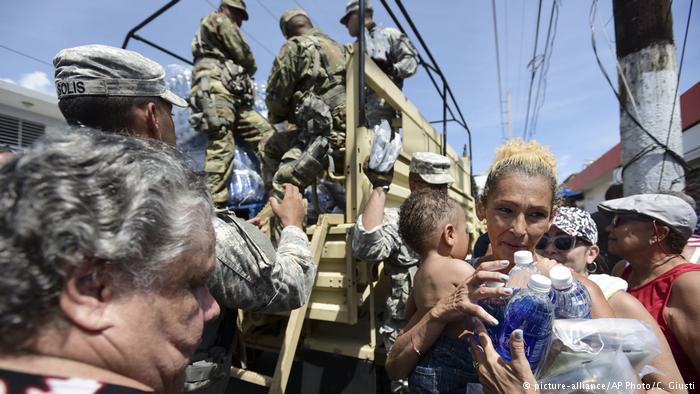
In conclusion, much of these NIMS affairs have been put to the test during the recent hurricane aftermath on the island. US federal aid - and lack thereof - has made global headlines.
Tools are currently employed “to register community resources, such as the National Incident Management System (NIMS) resource inventory management for rural communities, are designed for professional emergency services but do not recognize the full range of potentially relevant community assets”.
Therefore, how Puerto Rico united and divided from mainland US agenda will be educative to cooperative emergency disaster events in the future.

