
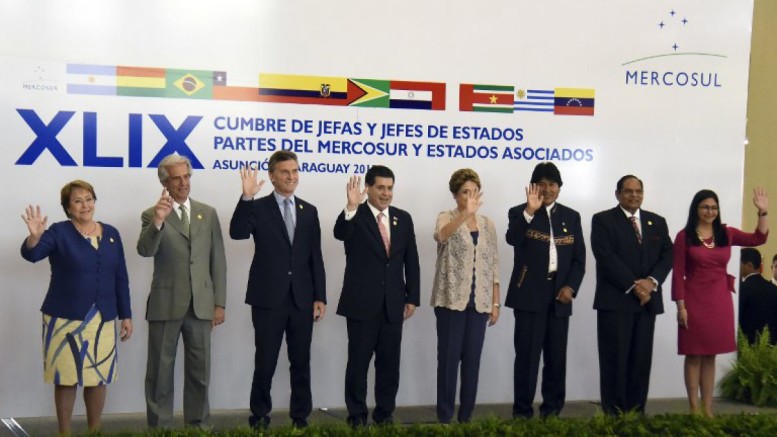
Venezuela’s assuming of the Mercosur pro-tempore presidency has not only tested the regional economic bloc’s crisis-era resilience, but furthermore right and left-wing governmental relations - public and private.
The re-questioning of the Bolivarian-ruled oil giant’s Mercosur membership marks a corner stone in South America’s historical bell shape curve.
As Pink Tide-era dominance gives way to another trend of economic-political “saviors” - this time the return of center-right to right wing personalities - Mercosur’s troubles shed light on much larger, subliminal themes.
Certain opposition has criticized mass-media for overlooking this situation’s hypothetical political intentions. This includes isolating the continental left and breaking the block in order to further integrate other proposals for more pro-Western trade activities.
Therefore, striving to better comprehend the various alternative perspectives is becoming increasingly insightful into this conflict’s big picture root causes.
ARGENTINA: Macri, UN, and the US
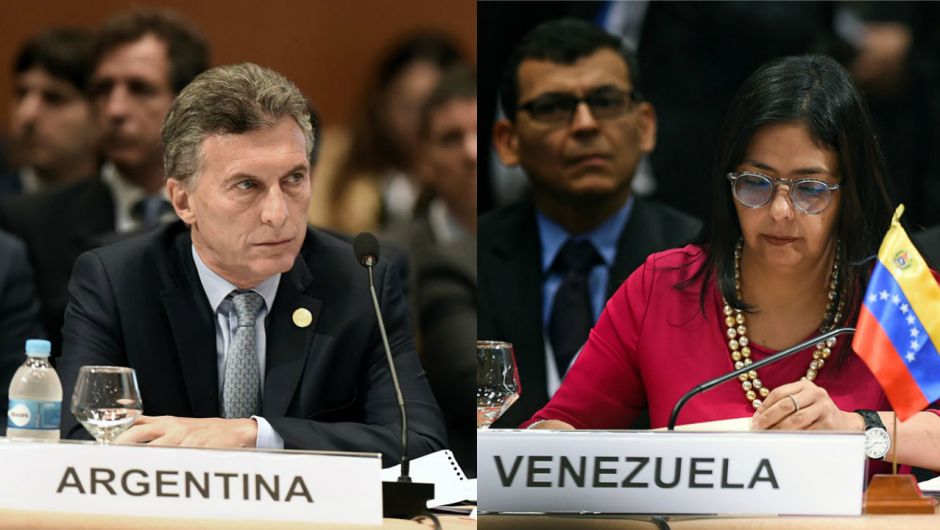
Macri: “What is happening in Venezuela is a disaster. Maduro’s government has to lead a referendum and elections so Venezuelans can undertake a path of dialogue, respect and democratic coexistence “. Photo (c) Diario Broward 2016
“I do not agree that Venezuela should assume the Mercosur presidency,” Macri claimed during an interview to BuzzFeed - a US-based website typically dedicated to entertainment industries, “They did not meet the requirements four years ago. It has no right to exercise this presidency. It is not a full member. ”
Macri had previously asserted that he was willing to go “to the end” to support the release of alleged political prisoners in Venezuela and freedom of expression in the country.
Likewise, the businessman and politician added that, “What is happening in Venezuela is a disaster. Maduro’s government has to lead a referendum and elections so Venezuelans can undertake a path of dialogue, respect and democratic coexistence “.
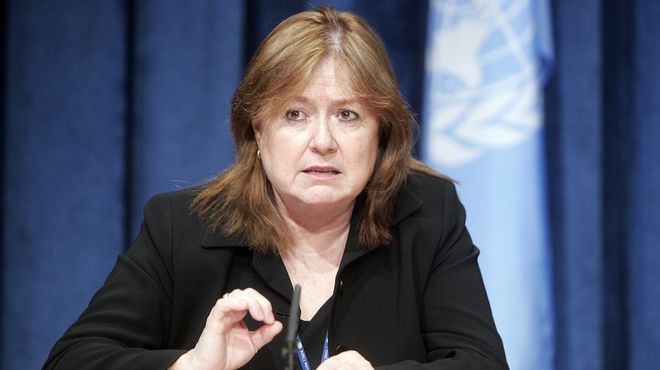
Foreign Minister Malcorra’s UN Secretary General aspirations may overlap Argentina’s position on Venezuelan Mercosurability. Photo (c) Semanario Preguntas 2016
The change in Macrista Argentine posture - which until now had been voiced by Chancellor Susana Malcorra and had been fairly balanced in both the Organization of American States (OAS) and Mercosur - has been alleged by some critics to be due to the Argentine diplomat’s attempt at being elected Secretary General of the United Nations.
Such strategy would hypothetically give Malcorra a strategic edge over potential competitors, including ex-UN Women head and current Chilean President Michelle Bachelet. Bachelet is a center-leftist politician with a generally positive international reputation but currently troubling internal affairs.
Furthermore, it has been speculated that United States Secretary of State John Kerry’s recent Buenos Aires visit allegedly involved this change of Argentine posture in exchange for the strategic commitment of the northern power with Malcorra’s UNSG nomination.
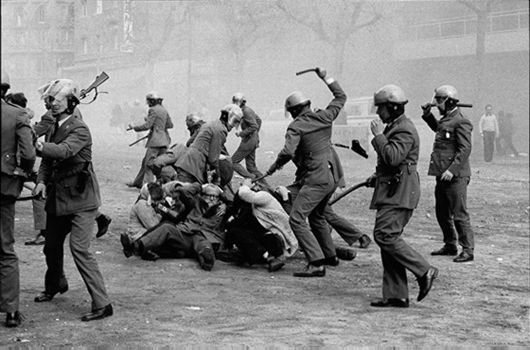
The administration has also engineered the release several Dirty War-era military and police officers. Photo (c) Archivo Nacional 1976
Peronist opposition criticize the Macri administration for its strong program set that has increased public tariffs, generated large public employment cuts of Kirchnerite “noquis”, criticized and eliminated media opposition.
Hebe de Bonafini - President of the Mothers of the Plaza de Mayo, an organization aimed on reuinted childeren kidnapped during the dictatorship-era with still living family members - has been described by the President as “deranged”.
The administration has also engineered the release several Dirty War-era military and police officers who had been convicted of serious human rights violations during the last dictatorship in Argentina.
PARAGUAY: Old Allies and Feuds 2.0
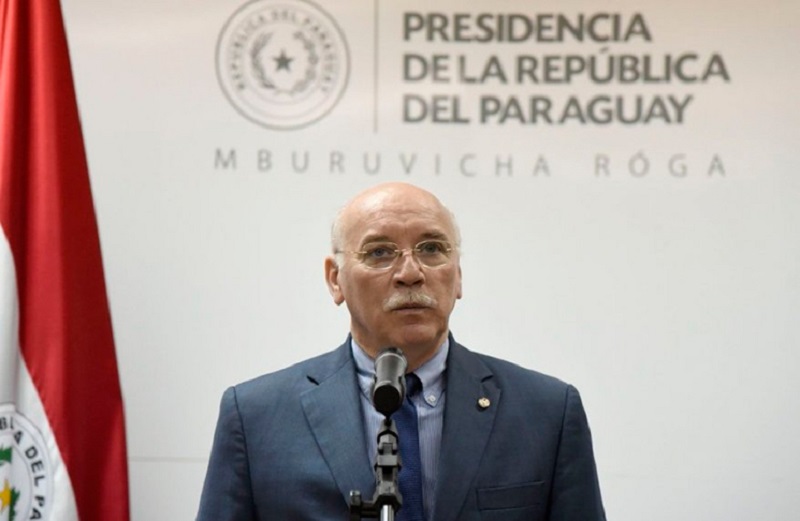
Loizaga has represented the Cartes administration’s main voice in rejecting Venezuela’s Mercosur pro-tempore presidency. Photo (c) Los Reportes Del Ichi 2016
Paraguayan Foreign Minister Eladio Loizaga said last June that a country chairing Mercosur, “must have democratic credentials, respect for human rights, and many economic stability.”
Loizaga has represented the Cartes administration’s main voice in rejecting Venezuela’s Mercosur pro-tempore presidency.
His past includes links to the Alfredo Stroessner dictatorship (1954-1989) and the World Anti-Communist League (World Anti Communist League, WACL), which held its XII Latin American congress Asuncion in 1977.
Before the announcement of Venezuelan Chancellor Delcy Rodríguez regarding the pro-tempore Mercosur presidency from Uruguay, her Paraguayan counterpart said that, “Paraguay does not accept this self proclamation of Venezuela in the exercise of the Mercosur pro tempore presidency”.
“The Chancellor (Uruguay’s Rodolfo Nin Novoa) made an uncounseled announcement to deliver the Mercosur Presidency (to Venezuela) without convening a Summit of Presidents,” Loizaga rationalized, “That is why we have reacted strongly”.
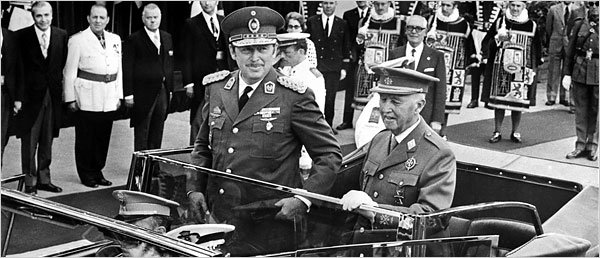
Paraguayan Dictator Alfredo Stroessner being welcomed by Spanish Dicator Francisco Franco in Madrid. Photo (c) ABC Paraguay 1973
The Paraguayan Foreign Minister added that the trade bloc is being conducted ,”in coordination among the three countries, Argentina, Brazil and Paraguay, to find a solution as soon as possible”. Uruguay - also a Mercosur founding member as well as a powerful headquarters - was conscientiously excluded.
“Do not forget that there is a party in Uruguay, the Frente Amplio, which is in exercise of government at this time and logically should be of important closeness to Venezuela,” Loizaga continued, “Unfortunately, ideological identification delay Mercosur”.
Loizaga was appointed chancellor by the government which emerged after the parliamentary coup that ousted elected President Fernando Lugo and made Paraguayan Vice President Federico Franco President in 2011. He has continued to serve under billionaire President Horacio Cartes.
BRAZIL: Questionable Coup Detats and Echoing Agendas
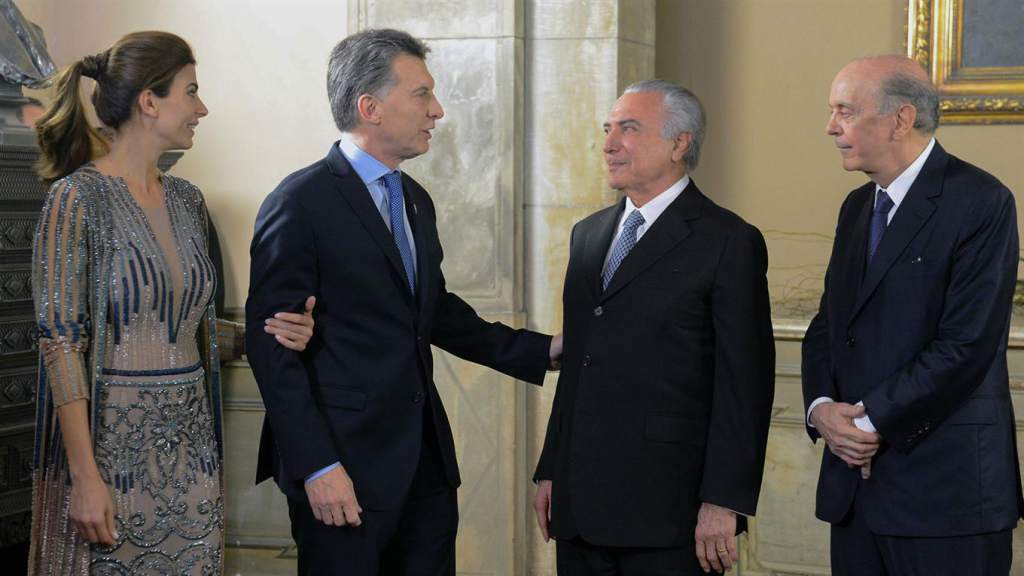
Brazil’s stance on Venezuela’s Mercosur presidency parallels its neighbors. Photo (c) La Prensa Honduras 2016
The government of President Michel Temer emerged from what opposition call a “coup detat” engineered by the majority of the Brazilian Senate against the government of President Dilma Rousseff.
Besides executing hasty privatizations and un-doing social policies and ministerial portfolios in charge of serving vulnerable sectors of society, Foreign Minister Jose Serra - named by Temer, whose critics claims is also under suspicion - is a promoter of the thesis of breach by Venezuela of some Mercosur treaties.
Serra has echoed that the pro-tempore presidency will be given to Venezuela, “once the Caribbean country meets some institutional rules after the four years it has failed to implement them.”
Serra joined the “non-political” argument that claims to uphold the ideological burden of the statements made by Loizaga and Macri, among other spokesmen of right-wing governments of these three Mercosur countries .
MERCOSUR in Chavista Venezuela’s Eyes
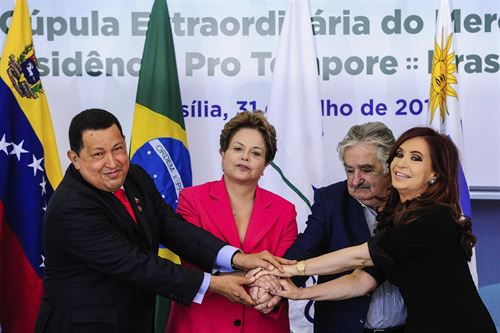
Chavez was integral to Venezuela’s acceptance into the South American economic bloc, fighting for more than six years. Photo (c) El Universal Colombia 2012
For the crisis-soaked Maduro administration, late President Hugo Chavez’s reflections still echo into the present.
Since 2006, the regional anti-Western icon viewed the economic bloc as a not only a symbolic, but strong step into his interpretation of a Latin America reliant on more so-called novo-mundo sovereign relations rather than traditional trade deal dependencies.
However, many public and private sectors raised concern on Chavista Venezuela’s ability to compromise Bolivarian policies with a multi-viewed organization.
Venezuela was finally admitted into Mercosur July 31, 2012 in Brasilia after parliamentary-coup-stricken Paraguay’s banning.
During the summit, mid-chemotherapy Chavez expressed that, “We are in that exact historical perspective, this is our world, our place in history, this is our place, this is our essence, South America and within this great bloc Mercosur as a great engine. Venezuela reaches the Mercosur completely, with all our passion, will and desire to integrate with dignity into a new mechanism of integration that goes beyond trade.”
“We have begun to have a homeland again, preserve the independence and with it the overall development and Mercosur is, if in doubt, the largest to preserve the independence and integral development to ensure our locomotive,” added Chavez.
Therefore, what comes into question from such diversely contradicting agendas - all accompanied by strong advocates and fluently versed arguments on all sides - reminds us of the vitality of analyzing the opposition critics losing ground in this bell shape curve, as history predicts that few paradigm changes come without contradictions and strife until the end.

