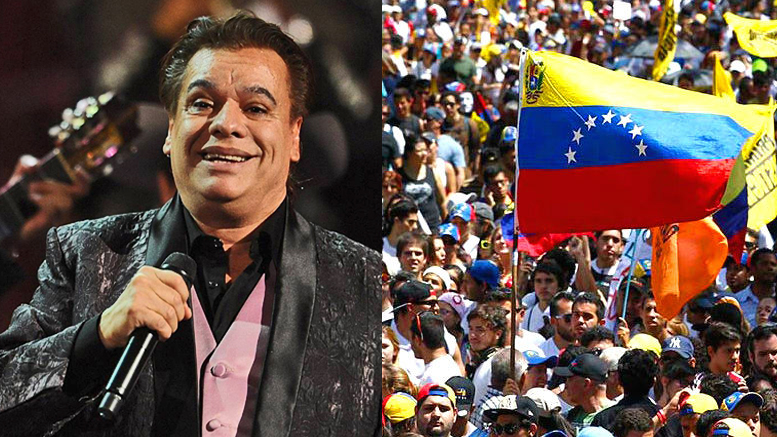
What does the Venezuelan crisis and Mexican Singer Juan Gabriel’s death have in common?
Or one could approach the same big-picture question another way: Many cultured book worms enjoy when the same story or topic is told in different ways. Let’s take on dragons.
Pete’s Dragon aside, the West traditionally portrays dragons as mostly evil, terrifying monsters. The East portrays them as also powerful creatures, but one that many Chinese parents try to give their children as zodiacs for their symbolic bravery and luck. Meanwhile, historically colonized Asian-Pacific islands and certain Latin American indigenous populations have combined Old World tales with native lore, ranging between omniscient marine navigation aids to malevolent shape-shifters worthy of slaying.
Is asking which perspective is “right” even the “right” methodology? Differences, ad infinitum.
Therefore, comparing diverse interpretations of a single subject is not only enjoyable at a leisure level, but furthermore valuable to average readers and professional analysts alike.
How It Is Accomplished
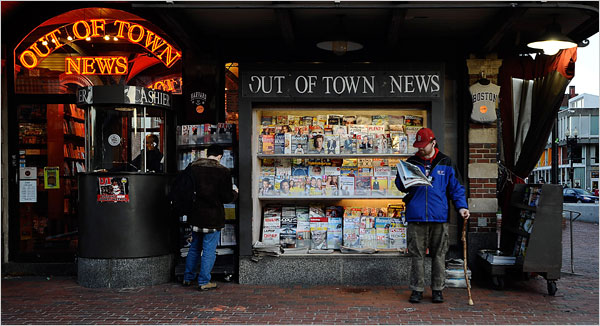
Every day, single events are covered thousands of times by thousands of different sources from hundreds of countries. Photo (c) NY Times 2016
Every day, single events are covered thousands of times by thousands of different sources from hundreds of countries.
Governments collect an eclectic bundle of such stories. Part of their job involves “gleaning” for actual “facts” which can be pragmatically applied - such as to national security, intelligence operations, and multinational investment trends.
But what about everyone from the average citizen to the globe-trotter? The way “the news” covers topics influences populous opinion in major and minor, overt and covert mannerisms, thus testing the line between perception and reality.
How much goes over the casual bystander’s head can be mind boggling. And many times, it isn’t even the readers’ fault.
Shouldn’t we be able to trust mass media and opinion? Isn’t it “mass” for a reason? Your call.
Meanwhile, how else is there to interpret events conscientiously and for a purpose, while not sacrificing time and adhering to the so-called “noise”? Consider the following cross-industry examples:
ENTERTAINMENT INDUSTRY: Mexico’s Juan Gabriel
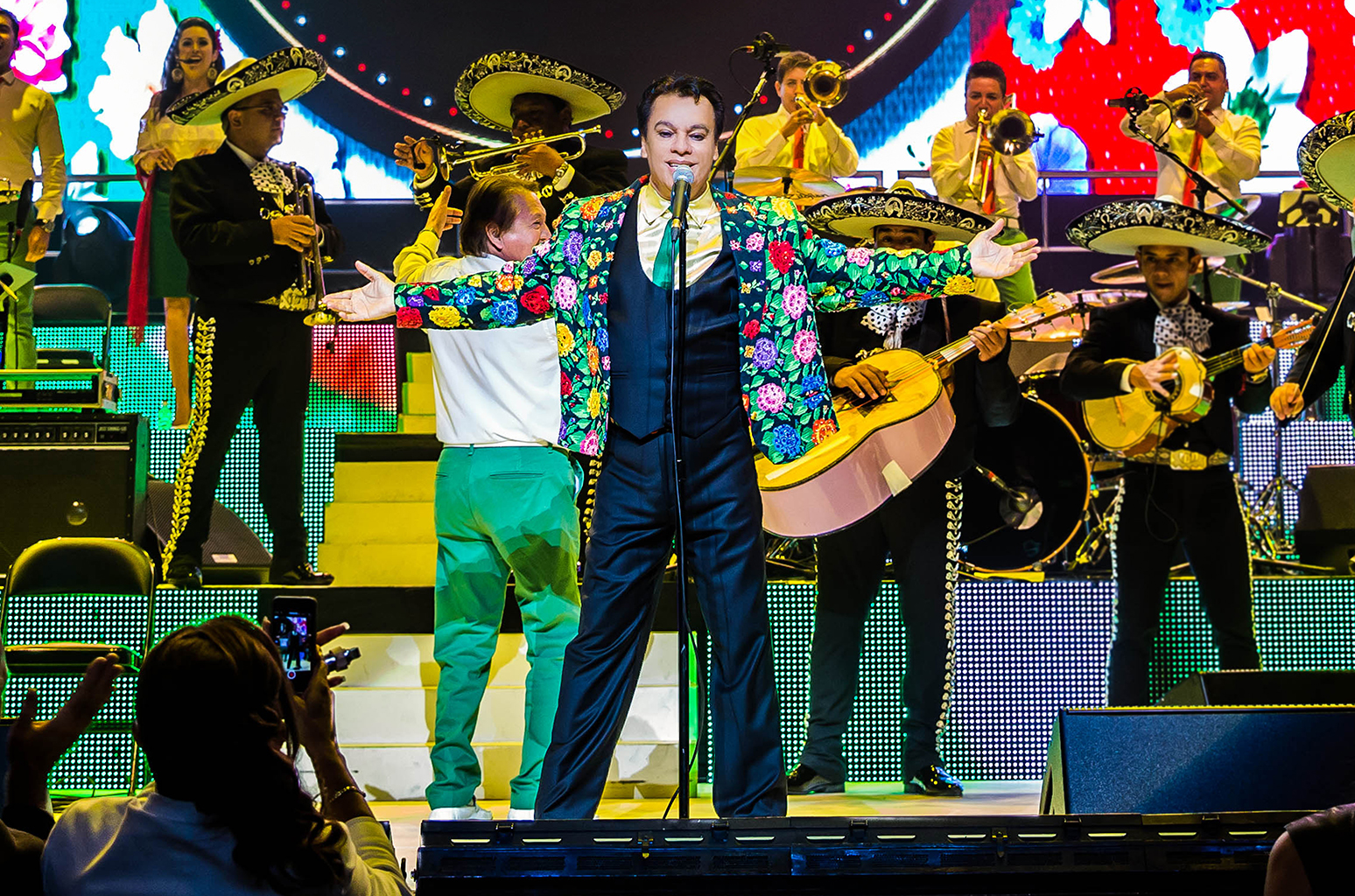
It regards the fabric of a cultural legend left to the whim of those who remain in power to uphold or derail it for individual interests. Photo (c) Billboard 2016
Prolific Mexican singer Juan Gabriel’s death is only one recent example of mixed accounts that can change large scale perception. Analyzing just the alleged circumstances of the celebrity’s death is sufficient.
Some sources claim that Juan Gabriel died alone at home. Others claim he was surrounded by his children and his death was only noted when he “over slept”. Others claim that his newest alleged boyfriend - an aspiring 25-year old singer - was at his side.
At least all can agree on location, date and cause - United States, August 28 2016, and heart attack. Well, at least most of them. It is more than can be said for late Venezuelan President Hugo Chavez’s demise. But that’s for another article.
So no, “El Divo de Juarez”‘s passing away (unless he’s decided to doppelgange the Elvis Presley “still alive” conspiracy, which is yet another circulating theory) doesn’t involve policy or economy, per se.
Instead, it regards the fabric of a cultural legend left to the whim of those who remain in power to uphold or derail it for individual interests.

Juan Gabriel business has been doing well since his death in early August 2016. Photo (c) El Horizonte Mexico 2016
On one end, many celebrities, news and entertainment companies have experienced a sudden spike in Juan Gabriel related stories, publicity ventures and consumer products.
Many of Amazon Prime’s supply of the singer’s CDs are “temporarily out of stock”. Collector items such as former performance outfits have increased hundreds to thousands of dollars. Shakira is allegedly considering joining the bandwagon of an album covering the late gay icon’s best selling hits, along with other artists.
Even one of Pulsamerica’s recent big social media hits is an article on him, titled “CULTURE: Mexican Singer Juan Gabriel’s Death Re-Births Issue of Gay Rights in Machista Societies“.
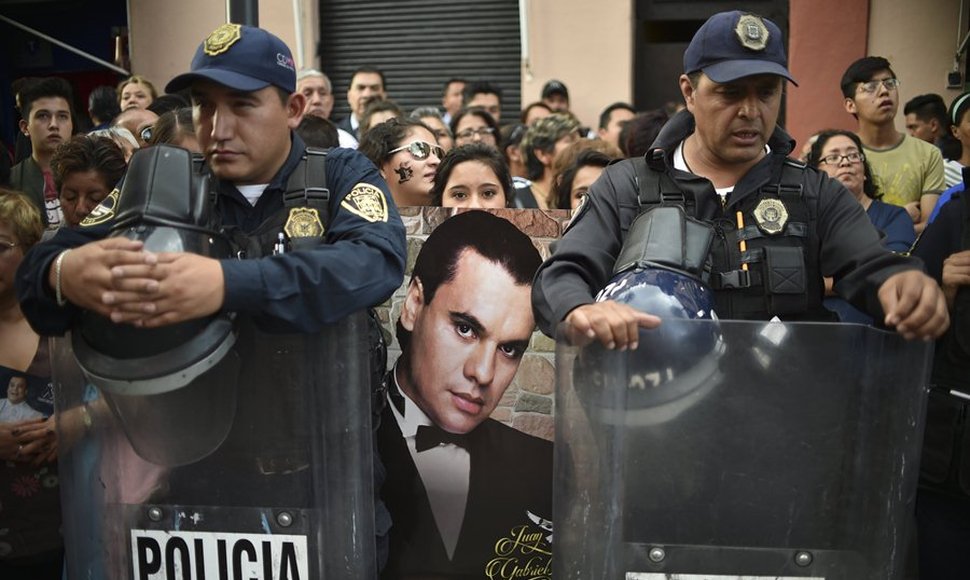
Another theory involves alleged Cartel de Juarez backing of major show deals and luxury private transportation for El Divo de Juarez. Photo (c) Univision 2016
On the other hand, some publicity ventures are classically taking the alternative route of boosting personal gain of living persons by alleging negative, polemic accounts on the dead. In this case, it has so far included everything between one Mexican talk host actually being flamboyant singer’s ex-girlfriend to him attempting to steal another woman’s husband. Another theory involves alleged Cartel de Juarez backing of major show deals and luxury private transportation for El Divo de Juarez.
But what about when it comes to socio-political and economic affairs, when not only the hearts, but the security and wallets of different levels of society stand at risk?
Things can get more complicated.
ECONOMIC, POLITICAL, SECURITY AND SOCIAL SPECTRUM: The Venezuelan Crisis
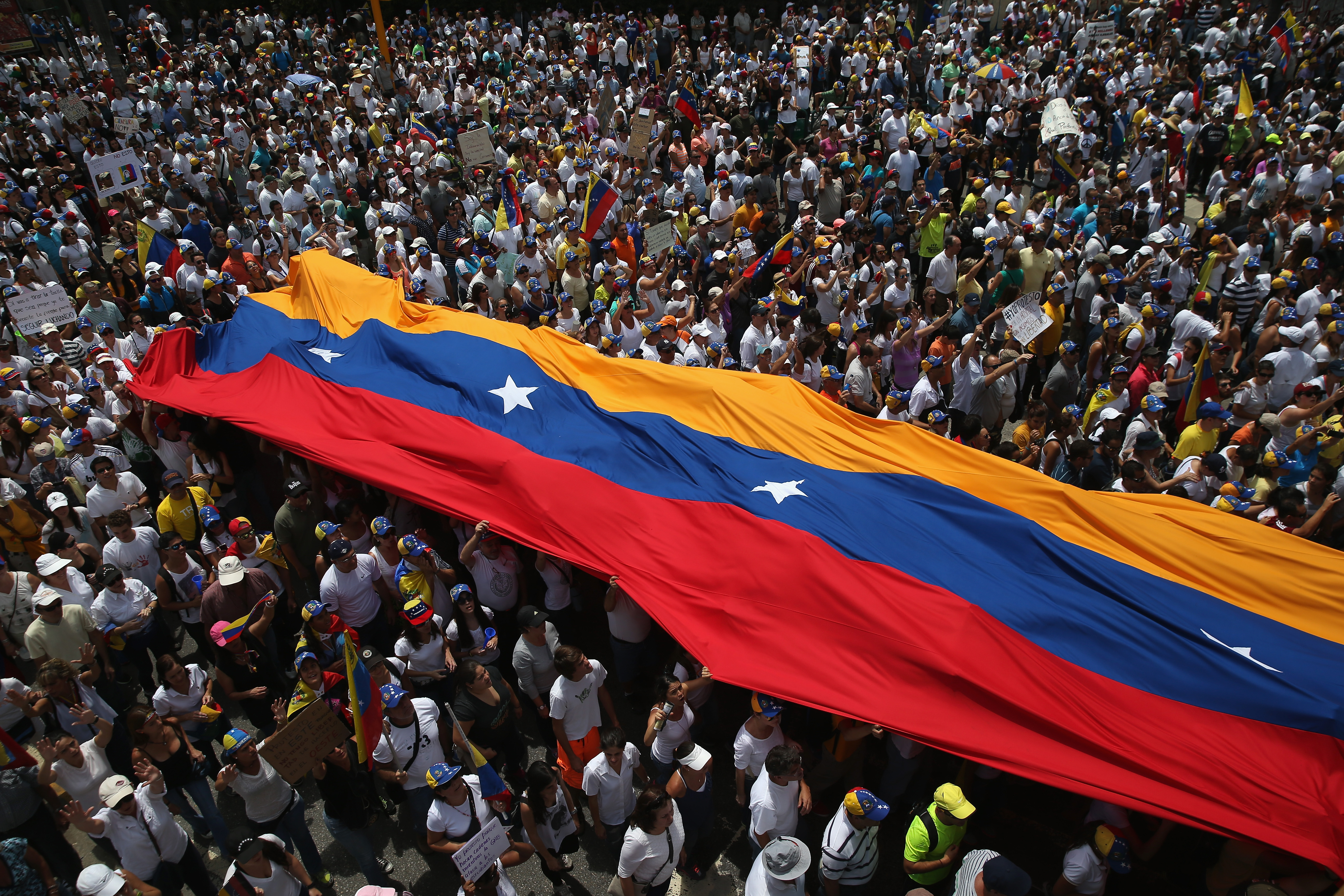
The Venezuelan crisis is also one of the most controversial and cross-industry significant. Photo (c) Foreign Policy 2016
One of the hottest international relations topics since long before late President Hugo Chavez’s death in 2013, the Venezuelan crisis is also one of the most controversial and cross-industry significant.
As accomplished with the previous mini-analysis on Juan Gabriel, tackling a single, vital avenue of such a vast theme is sufficient - the protests.
Protests are being held in many parts of Venezuela and lack a truly center direction, being convened through social networks. In demonstrations, opinions differ on opposition political parties, so it is possible to find as many expressions of support for the government as rejection. In Caracas, opposition protests are especially executed by sectors of the middle class and academia. Across the country, however, protests have incorporated a wider mix of popular sectors.
Back in Caracas, highly-publicized requests are mostly political, regarding freedom for detainees and the resignation of President Nicolas Maduro. Talk elsewhere incorporates social demands critical to inflation, alimentary and electrical shortages, illegal border crossing, as well as lack of other basic services and populous-affordable products.
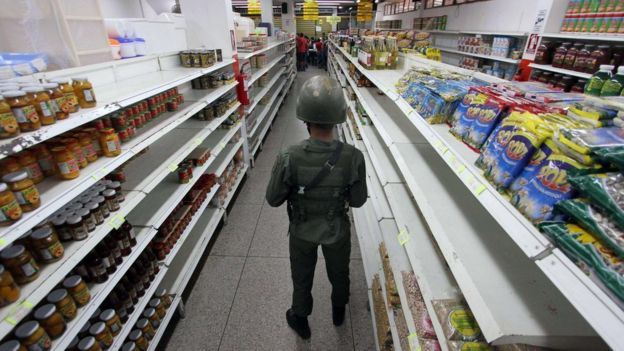
The international left continues to give back to them and uncritically support the state version of an “on-going coup detat”. Photo (c) BBC 2015
While some protests have turned infamously violent - using up to firearms against police and paramilitaries - most of the protests, especially outside of Caracas and Barinas - remain relatively peaceful.
It is also noteworthy that Venezuela - traditionally an oil giant - once had low levels of historical political culture in the population compared to its South American neighbors, so opposition protesters have the same problem of “content” that the support bases of the ruling.
The international left continues to give back to them and uncritically support the state version of an “on-going coup detat”, leaving thousands of protesters at the mercy of the mostly conservative speeches of opposition political parties without anti-capitalist, revolutionary referents and social change to influence them.
In this regard, the arrest of opposition Conservative leader Leopoldo Lopez is becoming a strategic and almost exclusive monopoly as a dynamic go-to alternative of incumbent Bolivarianismo.
Yesterday, Today and Tomorrow
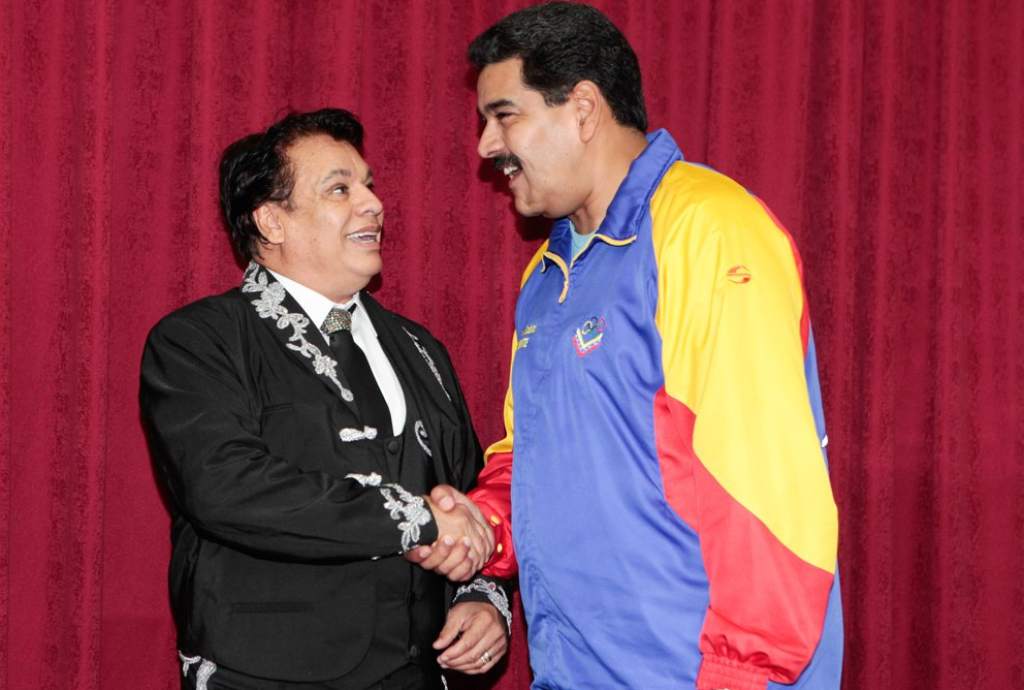
Singer Juan Gabriel and President Nicolas Maduro pictured in 2013 during an official visit to Palacio Miraflores…actually beside the point. Photo (c) La Prensa Honduras 2013
In conclusion, what connects a Mexican singer’s death and Venezuela’s troubles?
At least one compelling point is clear.
Where agenda-abundant utilitarianism and actual accounts begin and end can be naturally head-ache inducing to the point that most of us with full fledged lives throw up our hands and either (1) settle with a single source / opinion, (2) don’t care, or (3) get to the bottom of it.

Shouldn’t we be able to trust mass media and opinion? Isn’t it “mass” for a reason? Your call. Photo (c) Getty Images 2016
When it comes to entertainment smut, “getting to the bottom of it” is type-casted to the likes of Perez Hilton, E! Entertainment, Televisa Espectaculos and other newsertainment hubs (or Pulsamerica mixing pop culture with politics and human rights).
However, when it comes to national and international events, open-source readers from nearly every level of the socio-economic spectrum remain at the mercy of an influential cycle.
It is the same “the news” and “they say” mentalities that newsertainment originates, but from a position of authority and power equilibration with the ability to impact everything from daily lives to historic policies.