
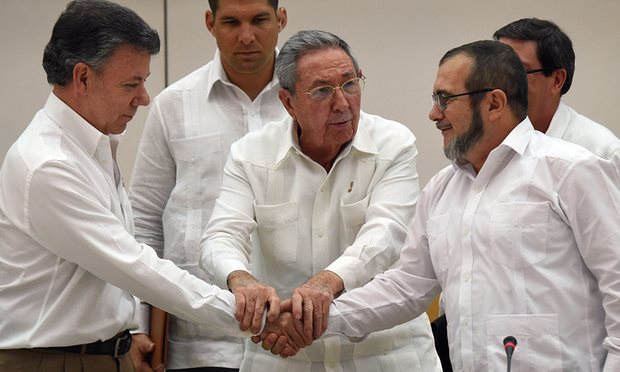
The permanent ceasefire between the Colombian government and the FARC (Revolutionary Armed Forces of Colombia) appears to be holding.
The ceasefire, which took effect on the first minute of Monday this week, comes days after the Government and the FARC signed a momentous peace deal, rounding off four years of negotiations and over half a century of war.
The left-wing FARC began their fight against the state in 1964, and were mainly made up of rural people who felt disenfranchised by the government. Over the following decades, however, the guerrilla army became increasingly dependent on kidnap, extortion and “taxing” illegal commerce such as the cocaine trade.
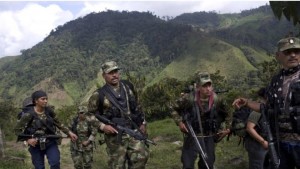
Fighting has been concentrated in the most inaccessible areas of the country. Photo (c) BBC 2016
The ensuing violence claimed more than 220,000 lives and more than 5 million Colombian people have been displaced from their homes, with citizens from rural areas bearing the brunt of the violence.
But the recent developments show that, some Colombians at least, want to put the violent times behind them.
Indeed, the FARC have agreed to hand over all of their weapons to UN sponsored monitors within six months of the peace deal being signed. In return, they will receive a minimum of 10 congressional seats, marking their transformation from guerrilla army to legally recognised political party- whose new name is yet to be chosen.
As the head of the FARC, Rodrigo “Timochenko” Londoño, put it—“Never again will parents be burying their sons and daughters killed in the war. All rivalries and grudges will remain in the past.”
Whether this is indeed true depends on which way the Colombian people decide to vote in the plebiscite which is due to be held October 2 and upon which the fate of the whole peace deal is held in balance. Colombians will choose “yes” or “no” to the question—“Do you support the final agreement to end the conflict and the construction of a stable and long-lasting peace?”
And it is not obvious which side will win. The “no” camp, which has the influential ex- president Álvaro Uribe as a figurehead, had been vocal in its demands for justice over what they see as unsatisfactory peace.
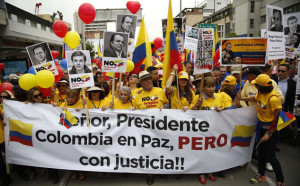
Opponents of the peace deal march through the streets. Photo (c) The Daily Mail//Fernando Vergara
“No” campaigners are also particularly opposed to the clause in the peace deal which allows war criminals to avoid prison, provided that they collaborate fully and truthfully with the proceedings.
The “yes” group, however, believe that prioritising forgiveness over justice is the only thing that will put an end to a war that has claimed so many lives and will allow Colombia to move forward as a country.
If “no” wins, and the Colombian people vote against the deal, then proceedings will be forced to stop.
As President Juan Manuel Santos has stated, “The Colombian people will have the final word.” The international community can only provide support and hope that the Colombian people accept one of the hardest things of all—that this is a war that neither side can win, and that ideas of justice must sometimes give way to forgiveness.

