
Ex-military members stand trial in Rome for alleged role in Operation Condor crimes; Precedent of Latin American human rights trials in Europe; Numerous witnesses travel to Italy to testify
Europe’s first trial in connection with the crimes committed as part of Operation Condor is currently underway in Rome. The trial is seeking to shed light on the death and disappearance of 23 Italians orchestrated by members of military juntas across Latin America during the 1970s and 1980s.
Operation Condor was a regional campaign by military dictatorships aimed at rooting out subversive political opposition and eradicating leftist ideology. Between 1976 and 1980, the governments of Argentina, Bolivia, Brazil, Chile, Paraguay and Uruguay coordinated actions including targeted abductions, disappearances, interrogations and torture and the transfer of people across the borders. Targets included guerilla fighters, political opponents and journalists amongst others.
The campaign was made possible due to an extensive surveillance network across the region and close coordination between the dictatorships, as well as due to undercover support from the U.S. government.
The current proceedings in Italy have once more shed light on this bloody campaign. In total, 32 defendants are being tried for their alleged role in the operation from Uruguay (16), Chile (11), Peru (4) and Bolivia (1). Amongst those who stand accused are Juan Manuel Contreras, the ex-head of Chilean secret apparatus DINA, and the Peruvian ex-president Francisco Morales Bermúdez.
Investigations into the case have been ongoing since 1999 when family members of the disappeared filed their complaints in Italy. But the notoriously slow pace of Italian justice, combined the complexities of the transnational investigation have delayed the trial until now.
Since 1998, European courts have proved to be important for bringing perpetrators of human rights atrocities in Latin America to justice. In the initial period following the crumbling of dictatorial regimes on the continent, governments across the region, most notably Chile, were reluctant to use judicial instruments to prosecute former military personnel. Newly established democracies favoured ‘forgetting and moving on’ rather than dwelling on past abuses through prosecutions. As a result, amnesty laws were kept in place and non-judiciary mechanisms were developed such as cautious truth commissions and reparation payments for the victims.
The situation changed, however, following the arrest of General Augusto Pinochet in London in October 1998. Spain filed an extradition request to the British authorities for the ex-Chilean leader to face charges for crimes including torture and murder. For the first time in history, a national court made use of the principle of universal jurisdiction, which allows states to claim jurisdiction for serious international crimes regardless of where the alleged crime is committed.
Pinochet was released 503 days after his arrest on humanitarian grounds and would never be tried in Europe. However, the proceedings set an important precedent for victims of Latin American dictatorships seeking justice. Frustrated by the slow advances on domestic terrain and the opacity of judicial processes in Latin America, many brought their cases before European courts. The most important conviction in Europe was that of Argentine Adolfo Scilingo, an ex-naval officer, who in 2005 was sentenced to 640 years in prison by the Spain’s National Court for crimes against humanity.
Since then, Spain has narrowed its application of universal jurisdiction but trials for human rights violations in Latin America continue for those victims with a European connection. For example, a French court convicted 13 ex-collaborators of Pinochet’s dictatorship for their role in the disappearance of four Franco-Chileans in 2010.
The current trial in Italy, which begun in February 2015, is above all symbolic. The chances of seeing the defendants behind bars are slim given that only one of the 32 defendants, Jorge Troccoli, an ex-military from Uruguay, lives in Italy. The rest will be tried in absentia. A number of the defendants such as Juan Manuel Contreras are already serving prison sentences in their own countries.
Nevertheless, the numerous witnesses who have travelled half way across the globe to testify in court have stressed the importance of the trial not only on a personal level to overcome their own suffering but also for strengthening democracy in Latin America.
‘Democracy cannot be achieved without total truth and total justice,’ explained Estela Carlotto, president of the Argentine association Abuelas de Plaza de Mayo (Grandmothers of the Plaza de Mayo), who spoke at the Fondazione Lelio e Lisli Basso in Rome.
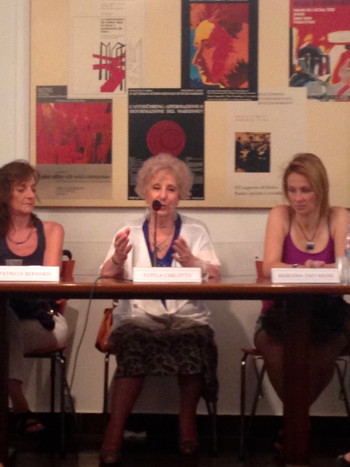
Estela Carlotto speaking at the Fondazione Lelio e Lisli Basso, Rome, 10 July 2015. Source: Alice Pease
Another Uruguayan witness reminded the audience of the decades of suffering which Operation Condor has caused. ‘It is not only the victims who are condemned by disappearances but entire generations.’
Other prominent witnesses who have travelled to Italy include Isabel Allende, a Chilean Senator and daughter of former president Salvador Allende and the president of the Chilean civil rights organization, Agrupación de Familiares de Detenidos Desaparecidos (Families of the Detained and Disappeared), Lorena Pizarro Sierra.
The willingness of so many individuals to testify before Italian judges is once more evidence of the vital role that civil society has played in seeking justice in Latin America. Non-governmental organizations, as well as individual lawyers and judges, have been instrumental in corroding the wall of impunity which for many years protected violators of human rights in the region.

[…] post Operation Condor trial underway in Italy appeared first on Pulsamerica: Latin American News, Politics and […]