
Ecuador’s credit with China sees big rise; Vice President Glas facing tax haven accusations; Chinese company to carry out mineral surveys
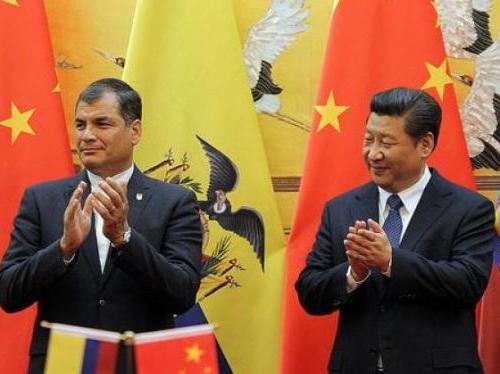
Ecuador’s credit with China sees big rise
On 7th January Finance Minister Fausto Herrera signed deals with several Chinese finance groups to increase Ecuador’s line of credit with the Asian nation to US$7.526 billion, up from a figure of US$6.589 billion in 2014.
The agreement came as part of an official tour of China by representatives of the Ecuadorian government. The tour ended on 9th January.
Of the five financial deals that were signed, the largest was with the Eximbank group for credit of US$5.296 billion in value. This money is intended for use in investments in social projects and infrastructure.
Eximbank also made a further US$250 million available for use in President Rafael Correa’s government’s plans to heavily promote the use of induction cookers in Ecuador.
Of the available funds it is thought that US$4 billion could arrive this year.
Recent figures had placed Ecuador’s credit needs at US$8,800 billion, however, following the fall in the price of crude oil this was cut back in a display of prudence.
Herrera said, “the trust shown by the Chinese Government is based on the stability and strength of the management of Ecuador’s economic policies, despite the adverse effects and external blows caused by the fall in price of crude oil”.
According to official figures from the Ecuadorian government, in November 2014 the country had a debt of US$4.748 billion with China, a figure that represents 28.1% of its total external debt of US$16.913 billion.
Amongst Ecuador’s other major creditors are the United Kingdom (US$1.136 billion) and the United States (US$447.6 million).
The agreements came alongside an announcement from Chinese President Xi Jinping that his country’s annual trade with Latin America would rise to US$500 billion over the next 10 years. He also committed China to a US$250 billion investment in the region over the same period.
Venezuelan President Nicolás Maduro also secured a deal for his country, reportedly receiving more than US$20 billion of investments from Chinese state-owned banks. This is added to the US$45 billion that Venezuela has received from China over the last 10 years.
Vice President Glas facing tax haven accusations
Vice President Jorge Glas has defended himself against claims that he was involved in the transfer of US$22.8 million to bank accounts in tax havens.
The accusation was made by Andrés Páez, a member of the CREO political party and a member of the National Assembly.
Páez sent a letter to President Rafael Correa, shortly before the Ecuadorian leader’s state visit to China, to make the claim.
He stated that he had evidence to demonstrate that accounts located in Panama and the Masor Islands, registered in the names of two people close to Glas, had been credited with large sums.
Glas struck back by accusing Páez of fabricating the whole issue in order to damage the reputation of the current government. He protested his innocence by noting that the Masor Islands do not exist.
Glas called upon the assemblyman to take the case to the legal system if he felt confident of his accusations, also stated that he himself would take legal measures if he feels that the accusations have any detrimental effects on his reputation.
Chinese company to carry out mineral surveys
On 9th January the Ministry of Non-Renewable Natural Resources signed an agreement with Powerchina Xibei Engineering Corporation Limited to allow the Chinese company to carry out geological surveys of Ecuador’s mineral resources.
It is hoped that this work will identify new sites with potential for mining. This comes as part of the government move to promote large-scale mining operations in the country.
Rafael Poveda Bonilla, Coordinating Minister of Strategic Sectors, emphasised that Ecuador has good-quality mineral reserves with low operating costs, alongside cheap electricity and political, economic, social and legal stability.
The Chinese firm will only be contracted to carry out the exploration phase of the plan, as the Ecuadorian government will maintain control over the extraction of the natural resources.
