

With the release of the ‘Paddington’ film at the end of last month, it is a great moment to explore the cultural symbolism and meaning behind Michael Bond’s creation, in which Andean South America and London converge. At its heart, ‘Paddington’ is a tale of immigration and cross-cultural insemination.
Paddington is a paradox. An exotic, South American ‘Other’ more English than the English. He is a migrant who comes to London from ‘deepest darkest Peru’, and after a clandestine trip, is quickly given the name of the station he is found at.
Paddington journeys to London because an earthquake has devastated his home. It is well known that the author, Michael Bond was influenced by seeing young Second World War evacuees at railway stations with little more than a suitcase and a label. But Paddington also has something to say about the tide of immigration to Britain following the end of the war.
Britain, with its waning empire and depleted workforce, was a popular destination for migrants, especially for those who had had cultural encounters with the country. Paddington bear is no different.
Montgomery Clyde, the British explorer who first comes across Paddington’s species of bear in the Peruvian Andes represents the benevolent face of British discovery, and say it quietly, easy-going imperialism. But Clyde also conveys Britain’s soft power, through marmalade, and says he would be only too happy to return the warm welcome should the bears come to London.
In the film, the villain is Clyde’s daughter Millicent, who wants to claim the credit her father never did for his ‘discovery’. She becomes a baddie driven by status and taxonomic self-importance. If her father has soft power, Millicent is a neo-colonialist.
Paddington is not the only foreigner to win the hearts of Londoners. Mr Gruber, the eclectic antique shop owner of the Portobello Road, is himself an immigrant, one who has, like Paddington, adapted, integrated and become loved by the community.
Paddington’s adopted family, the Browns, live at 32 Windsor Gardens and their address adds to Bond’s persistent treatment of immigration vis-à-vis Englishness. The parallels are striking. The royal House of Windsor, like Paddington, changed its name to improve its adaption and assimilation into British society. Just as Paddington’s Peruvian bear name is unpronounceable for the English, so the royal family took the name Windsor in lieu of Saxe-Coburg and Gotha due to anti-Germanic sentiment during the First World War.
At first, like Paddington, monarchs from the German dynasty of Hanover and the Saxe-Coburg and Gotha/Windsor struggled to conform to English expectations, before being regarded as the very epitome of Englishness. Phrenologically and physiologically, Paddington may not fit in, but other aspects of his appearance; his explorer’s hat and duffle coat, are quintessentially English.
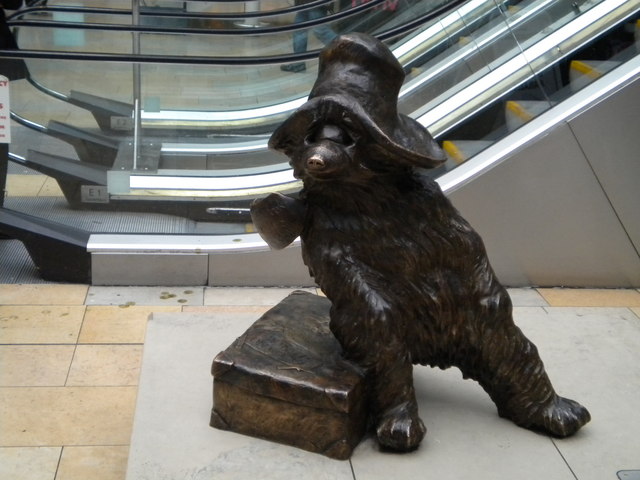
The bear at Paddington station. R Stones, geograph.org.uk, via http://upload.wikimedia.org/wikipedia/commons/e/e3/Paddington_Bear%2C_Paddington_Station_W2_-_geograph.org.uk_-_1769430.jpg
Since Shakespeare’s The Tempest, interactions between the falsely called ‘old’ and ‘new’ worlds have been seen from the perspective of the paradigmatic dynamic between Prospero, the coloniser, and Caliban, the dominated native. A strength of Bond’s creation is that Paddington is no Caliban. He is simple, yes; but no brute. In fact, it is Paddington, not the denizens of the ‘old world’, who provides the magic.
There are also echoes of the eighteenth century Swiss philosopher Jean-Jacques Rousseau, who developed his idea of the ‘Noble Savage’, arguing that humanity’s natural state is to live without the corrupting influences of society. But Paddington breaks though this characterisation and quickly becomes a ‘Noble Citizen’, albeit that he retains many of his Peruvian bear traits.
The Harvard political scientist Samuel Huntington argued in Who Are We?: The Challenges to America’s National Identity (2004) that due to technology and ease of travel, USA-based Latinos are now less likely to assimilate and create a United States American identity than ever before. Paddington however, assimilates in part because, having neither of those options, he has no alternative, but also because he brings eagerness and the Latin joy of life with him to London.
Paddington is an endearing character for young and old alike, but he is also a hugely symbolic bear, and immigration and cultural cross-insemination are at the heart of his charming story.
